Reading Time: 6 minutes
When you walk onto any jobsite, you’ll notice a thing: construction is never simple. Multiple trades, shifting schedules, complex building systems, and rising demands for accuracy all collide on the same timeline. The errors are costly, and rework eats into budgets and deadlines. For this reason, MEP BIM services and BIM modeling services have become indispensable. They establish a common, intellectual base upon which teams may confidently plan, organize, and construct.
This isn’t about adding another layer of technology for the sake of it. It solves real-world problems that the industry professionals face every single day. Let’s break it down.
What BIM Brings to Construction
Essentially, Building Information Modeling (BIM) is about making digital representations of physical spaces. However, it is more than 2D or 3D representations that combine data with every aspect of a design: geometric, material, specification, schedule, and cost data. This means that you will not only see how a building will be, but also understand how builders will build it and maintain it.
Work Smarter, Not Harder
iFieldSmart empowers your team with AI-driven efficiency to simplify scheduling, boost collaboration, and keep projects on track.
Schedule a MeetingFor contractors, BIM reduces uncertainty during the construction process. For owners, it provides visibility into what they are delivering. For consultants and fabricators, it creates a clear pathway from design intent to final installation.
And when you introduce MEP BIM services focused on mechanical, electrical, plumbing, and fire protection systems, you move from “nice to have” to “mission critical.”
Why MEP BIM Services Matter
Here’s the thing: buildings don’t fail because of walls or windows. They fail because the systems inside them clash, underperform, or exceed their expected costs. That’s where MEP coordination becomes the real battleground.
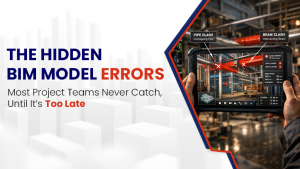
MEP BIM services bring structure to that process. Team members can develop detailed models of HVAC ducts, along with plumbing systems and electrical conduits, and fire protection layouts, and identify construction clashes before actual work starts. A duct that collides with a beam. A pipe that doesn’t have clearance. An electrical run that interferes with fire sprinklers. The model resolves all of it, not during installation.
This results in less rework, fewer delays, and cost control.
Software Expertise and Compliance Standards
Strong BIM work depends on strong tools and industry alignment. Leading BIM modeling services teams depend on platforms such as Revit, Navisworks, and Autodesk’s other platforms to build accurate, information-rich, and project-ready models.
Compliance also matters. By aligning with standards from organizations such as SMACNA for sheet metal, IEEE for electrical systems, and other international benchmarks, BIM teams ensure that models meet the intention and design manufacturing requirements.
The combination of technical expertise and compliance creates practical models compatible with code and ready for real-world construction projects.
From Design to Fabrication: BIM Engineering in Action
BIM engineering is essential for visualization and making sure the models are sufficiently precise to enable production in the real world. Fabricators may confidently cut, weld, and assemble using LOD 400 models since every dimension matches. Once a piece arrives on the jobsite, the guessing is done.
Firms like BIM Engineering US operate at this level of detail to assist contractors and fabricators in the transition from design intent to accurate, buildable models.
That’s not just efficiency, it’s predictability. And in construction, predictability is everything.
Specialized Deliverables That Make a Difference
When teams engage BIM modeling services or MEP BIM services, they should expect more than just general models. Specialized deliverables provide direct value on-site, including:
- Point cloud to BIM modeling for accurate digital twins of existing spaces
- Hangers and supports modeling for HVAC, plumbing, and piping systems
- Detailed shop drawings for plumbing sleeves, overheads, sheet metal, and electrical systems
- 3rd-party BIM model auditing to verify accuracy, quality, and compliance
- Construction drawings for field teams
- 3D virtual visualization for walkthroughs and design reviews
- Clash detection and resolution reports for coordination meetings
- On-site BIM support when project teams need real-time assistance
- Model data directly ties to procurement and QTD (quantity take-off)
Each discipline informs itself better to proceed. They keep the projects aligned, coordinated, and on track.
Key Deliverables You Can Expect
To recap, some of the most impactful outputs from BIM modeling services and MEP BIM services include:
- High-quality MEP models for design and coordination
- Fabrication-ready models at LOD 400
- Information-rich models at LOD 500 for facility management
- Shop drawings across HVAC, plumbing, electrical, and fire protection
- As-built models for close-out and future renovations
These are not just digital files; they are the working tools that keep projects moving forward with fewer surprises.
Where BIM Adds Value Across Disciplines
The scope of BIM engineering spans every trade and discipline. Here’s how it plays:
- Architectural BIM: Improves visualization and keeps owners and architects on the same page as design intent.
- Structural BIM: Improves visualization and helps owners and architects align with design intent.
- Mechanical BIM: HVAC system models for performance, energy efficiency, and spatial adjustment.
- Electrical BIM: Collaborates with power distribution and low-voltage systems with other trades.
- Plumbing and Fire Protection BIM: Facilitates code-compliant, safe layouts that prevent field conflicts.
- BIM Coordination and Clash Detection: Avoids disputes that can cause construction delay.
Each discipline is better informed to proceed. They collectively provide a dependable source of information.
Beyond Design: BIM for the Entire Project Lifecycle
A typical misunderstanding is that BIM applies only to design. In reality, BIM modeling services work through the project lifecycle.
- Preconstruction: Estimating, procurement, and 5D cost planning.
- Construction: A 4D schedule links a task and a time for meaningful sequencing.
- Prefabrication: For precise off-site assembly, trades employ BIM.
- Handover and Facility Management: As-built BIM models offer useful information for long-term operational instruments.
BIM is not just about designing a building; it also supports after the build. And it makes it one of the smartest investments a project team can make.
Industries Leading the Way
MEP BIM services and BIM modeling services apply to various types of projects. They’re shaping outcomes across sectors:
- Healthcare: Where complex MEP systems demand precision.
- Airports and Transit have massive infrastructure requiring coordinated workflows.
- Commercial and Multi-Family Housing: Where cost and schedule control are critical.
- Institutions and Education: Where visibility and accountability matter.
- Hospitality and Retail: Where design intent and customer experience need to align with functionality.
- Facility Management: Where thorough models lower maintenance expenses and operational risks.
The advantages multiply in each sector: reduced rework, improved coordination, and more seamless delivery.
The Foundation of Smarter Construction
Construction will never be free of challenges. But with BIM engineering at the center, those challenges become manageable. Models evolve into shared knowledge bases. It solves conflicts digitally, not in the field. Projects move with more certainty, and owners gain buildings that perform as promised.
That’s why calling BIM modeling services and MEP BIM services the foundation of smarter construction isn’t an exaggeration. It’s reality. Teams that embrace this shift do not just reduce risk; they set themselves up to deliver projects that meet expectations.
And in an industry where every dollar and every day counts, that’s not just smarter, it is essential.