Reading Time: 5 minutes
If you’ve ever tried to coordinate a big construction project, you know how easy it feels for things to slide sideways. One trade shows up early. Another shows up late. A critical piece of equipment isn’t on-site when needed. Before you know it, the schedule starts slipping.
Here’s the thing. You can gain a planning edge over traditional scheduling by integrating your 3D model with your timetable. You see the build sequence, spot issues early, and guide your team with confidence.
Let’s break down the top benefits and understand why 4D construction scheduling is becoming a standard for contractors, owners, and construction managers across the U.S.
Work Smarter, Not Harder
iFieldSmart empowers your team with AI-driven efficiency to simplify scheduling, boost collaboration, and keep projects on track.
Schedule a MeetingTop 10 Benefits of Using 4D BIM for Construction Project Coordination
1. Get a Clear Picture of the Entire Construction Sequence
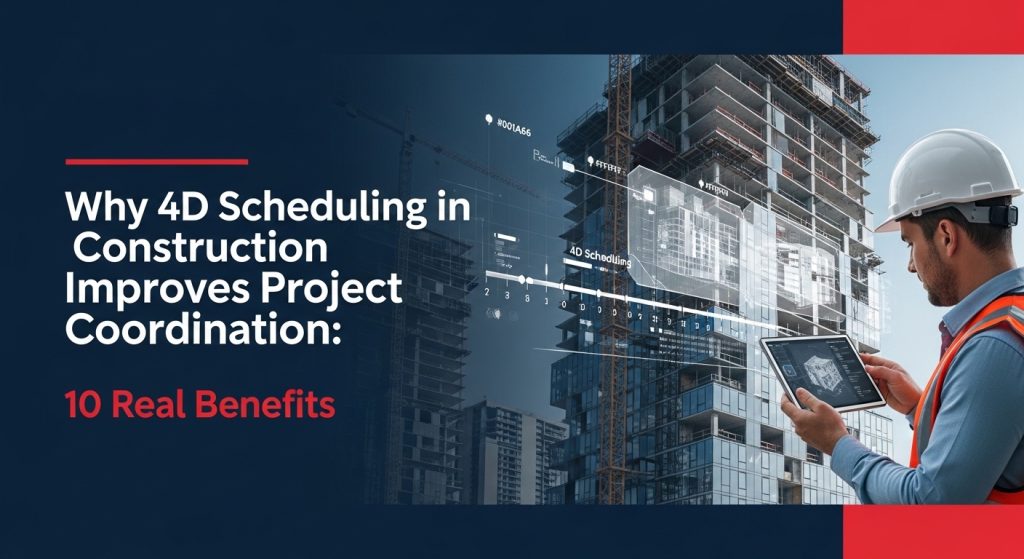
A clear view of the entire construction sequence helps teams make better decisions as the story unfolds. 4D construction scheduling connects the schedule to your BIM model, helping to visualize each activity in the exact order it occurs.
What this really means is simple.
- You see the project the way it will actually get built.
- Not as a list of dates.
- Not as a static Gantt chart.
- But as a living, evolving sequence.
This strengthens planning, communication, and early adjustments before work begins.
2. Prevent Construction Delays by Identifying Early Conflicts.
Every contractor fights with delays. Some come from design issues. Others come from poor coordination. Many come from misalignment between teams.
4D BIM scheduling helps you catch conflicts long before they affect the job.
Teams can test different scenarios, identify problem areas, and adjust their plan with time still on their side.
Common delays you can prevent through 4D:
- Access conflicts
- Structural or MEP overlaps
- Unclear work zones
- Misaligned material deliveries
- Labor scheduling gaps
You prevent trouble instead of reacting to it.
3. Improve BIM Coordination Across All Trades
Better coordination starts with a shared visual plan. 4D BIM builds that.
Trade contractors see what must happen, when it must happen, and what comes next.
Superintendents and project managers gain clarity on sequencing.
Owners understand progress without needing technical explanations.
4D scheduling in construction creates:
- Shared visibility
- Realistic timelines
- Fewer misunderstandings
- A coordinated execution plan
This reduces friction on site and keeps everyone aligned.
4. Strengthen Construction Schedule Optimization
Your schedule is only as strong as your planning. 4D BIM helps you build schedules that reflect real-world constraints.
Here’s how it boosts construction schedule optimization:
- It highlights activities that can run in parallel.
- It shows tasks that must wait for others.
- It reveals dependencies that your team may overlook.
- It exposes sequencing risks that aren’t obvious in 2D or written schedules.
- It helps you manage manpower needs more effectively.
It produces schedules that are realistic and operationally grounded rather than theoretical.
5. Improve Communication with Owners and Stakeholders
Not every stakeholder understands a Gantt chart or a CPM report. But everyone understands a visual timeline. 4D BIM makes communication easier.
Owners see progress.
Executives understand timelines.
Teams align without long explanations.
This improves:
- Approval cycles
- Change-order discussions
- Budget talks
- Progress reporting
- Stakeholder confidence
A clear visual schedule builds trust and transparency.
6. Support Better Site Logistics and Resource Planning
Construction site logistics can make or break your flow.
4D BIM helps you create a plan that accounts for space, access routes, storage zones, equipment positioning, and material movement.
This results in:
- Safer site conditions
- Clear access paths
- Better equipment usage
- Fewer traffic bottlenecks
- More predictable material handling
The same level of coordination applied to the structure is extended to the site.
7. Strengthen Risk Detection and Mitigation
4D BIM enables proactive risk management by identifying potential issues before work starts. You see clashes, overlaps, and structural conflicts early.
Key risks you can reduce:
- Out-of-sequence work
- Safety hazards
- Rework
- Material delivery conflicts
- Incomplete dependencies
- Scheduling bottlenecks
This helps you run the project with fewer surprises.
8. Improve Change Management and Scenario Planning
Changes happen on every project.
- A material gets replaced.
- A structural element changes.
- A new constraint appears.
4D BIM handles these changes without slowing you down.
You can:
- Re-sequence activities
- Update logic ties
- Test alternative construction paths
- Assess the impact of design modifications
- Present clear visuals of the updated plan
This gives you control over changes instead of letting changes control your schedule.
9. You Strengthen Field Planning and Daily Coordination
Superintendents and field teams work better when they see their daily tasks clearly.
4D BIM gives them exactly that.
They understand:
- What to build today
- What happens next week
- Which areas must stay accessible
- How trades must coordinate
- Where risks may appear
This reduces confusion and improves productivity.
In many companies, 4D BIM integrates with field tools that help teams track progress. For example, some teams use Lens360 by iFieldSmart to link visuals with planned sequences and on-site conditions. Similarly, companies partner with BIM Engineering US to implement reliable 4D BIM workflows that support field planning and sequencing.
10. Deliver Better Results and a Predictable Project Experience
This is the benefit that brings everything together.
When your project stays on schedule, avoids rework, reduces delays and improves communication, the overall experience is better for everyone.
4D BIM turns planning into a real advantage instead of a constant struggle.
Conclusion
4D scheduling in construction gives you a stronger and more predictable way to plan and coordinate your projects. When you combine clear visuals, real-time sequencing, and smart BIM integration, you remove a lot of the uncertainty that slows teams down.
The building business continues to develop toward more visual and more data-driven planning. It delivers instant clarity for planning and coordination. 4D BIM helps project teams make to make better decisions right away. 4D BIM plays a central role in the shift by enabling contractors, owners, and project managers to make better decisions.
4D BIM is a primary contributor to this shift, providing owners, contractors, and project managers with the insight needed for better decision-making.